Showing posts with label parenting. Show all posts

Monday, 13 January 2014

Do your kids a favour: make sure they learn how to ski (well)


My parents didn't get to ski when they were young. They were too busy with the Great Depression, the Second World War, and then with moving to the New World. My siblings and I bore the direct consequences of their ski-free childhood by having our own almost-ski-free childhood. I say "almost" because at the age of nine, I did get to spend three days on a class ski-trip. The ski-trip didn't turn me into a slalom queen, but I managed to learn some basics of downhill skiing.

I was 19 years old the next time I got to go skiing, and 25 years old the third time I got to go. Since meeting the Frenchman 13 years ago, I've had to opportunity to downhill ski a few more times; yet even after six years of consistent practice, I'm a competent skier but I will never be a great one or even a very good one. 

Great skiers start when they're young. Small children seem to know intuitively how to ski from the second they stand up on their skis and you push them gently down the bunny hill. They bend their little legs, spread them wide apart and away they go. They're not afraid. They might not know how to stop (at least until they learn how to do a proper snow plough) but even then, they're not scared. And they're close to the ground so if they fall, they don't fall far.


The inchoate sense of balance and confidence on skis never leaves a small child who's been skiing a few times, and children who learn to ski early on become excellent skiers later on.


Well, better skiers than their mom, anyway.

Is skiing an essential skill? No. It's probably not as important to learn how to ski as it is to learn how to swim. Swimming is an important - maybe even an essential - life skill. 

Skiing on the other hand is what I call an "upward mobility skill". Why? Because skiing is expensive. You have to rent or buy skis and boots. You have to buy your lift passes. You have to take lessons if you haven't skied before. And if you don't live close enough to the mountains to go just for the day, you'll either need access to a ski chalet or a hotel. Skiing is for the upper middle class and the upwardly mobile. And one day, your child will be (you hope, anyway) upwardly mobile.

If you think your child might get a university degree one day, maybe even a masters or a doctorate or a professional degree, you should make sure she learns how to ski while she is still young.  

What's so special about skiing? When your globetrotter adolescent spends a year in Europe on a Rotary Exchange or for his Junior Year Abroad, what will happen when his host family invites him for a weekend of skiing in the Alps? One of two things: if he already knows how to ski he'll be glad and relieved that he does. At worst, he'll take this fact for granted. On the other hand, if he doesn't know how to ski and he finds himself on the bunny hill all weekend while the rest of the family (including their teenage kids) is enjoying the real pistes, he'll almost certainly be asking himself, "How come I never got to learn this when I was a kid? Why didn't we ever do this?"

When your daughter is in college in Colorado or Utah and her group of friends decides to go skiing for the weekend, you may be glad to see her home from the weekend, but she'll resent and regret the fact that she missed a ski trip with her friends. 

But it doesn't stop at superficial college outings.  That job that your son will land when he's 25 years old in that international accounting firm, or advertising company in London? Well, they'll be having an office ski trip in the south of France every year. And guess who'll be cursing you for not making sure he learned how to ski? 

When your daughter is on the partnership track in a law firm in Paris, and wants to network with the senior partner (who grew up in Upper Savoy and was on the national ski team for a while), it will really really help if she knows how to ski. 

Do your kids a favour. If you have the money and the vacation time, take them skiing. If you can't ski, do what my friends Cécile and Guy do (because they can't stand skiing but they realise that it will offer a certain social value to their kids): send your kids to ski camp for a week or two every winter.  

Those ten years of violin lessons my mother forced me to take? A complete waste. It was obvious from year three that I was hopeless.  Forget the music lessons unless your kid enjoys it or has an obvious talent for it, of course. Teach her how to ski. Her business and social network will care very little about how well she plays violin, unless she does it for a living. On the other hand, if your child attends university, the chances that there will be a ski outing at some point in your child's future professional or social life is fairly high.

And if you can't appreciate the idea that skiing will be a good skill for your kids to have in the long run, just enjoy the smile that you'll see on your kids' faces when they get their achievement medals at the end of the week. This year, it was a "flocon" (snowflake) badge for the Bambino and a bronze star (étoile bronze) for the Bambina.


Other upward mobility sports are golf and tennis. It's good to know how to play these, too. I can remember our office having a golf and tennis day. Guess who had never played a game of golf in her life? So I signed up for tennis instead (which I also had never played). Also a disaster. 
Tuesday, 24 September 2013

Raising Freethinking Globetrotter Kids

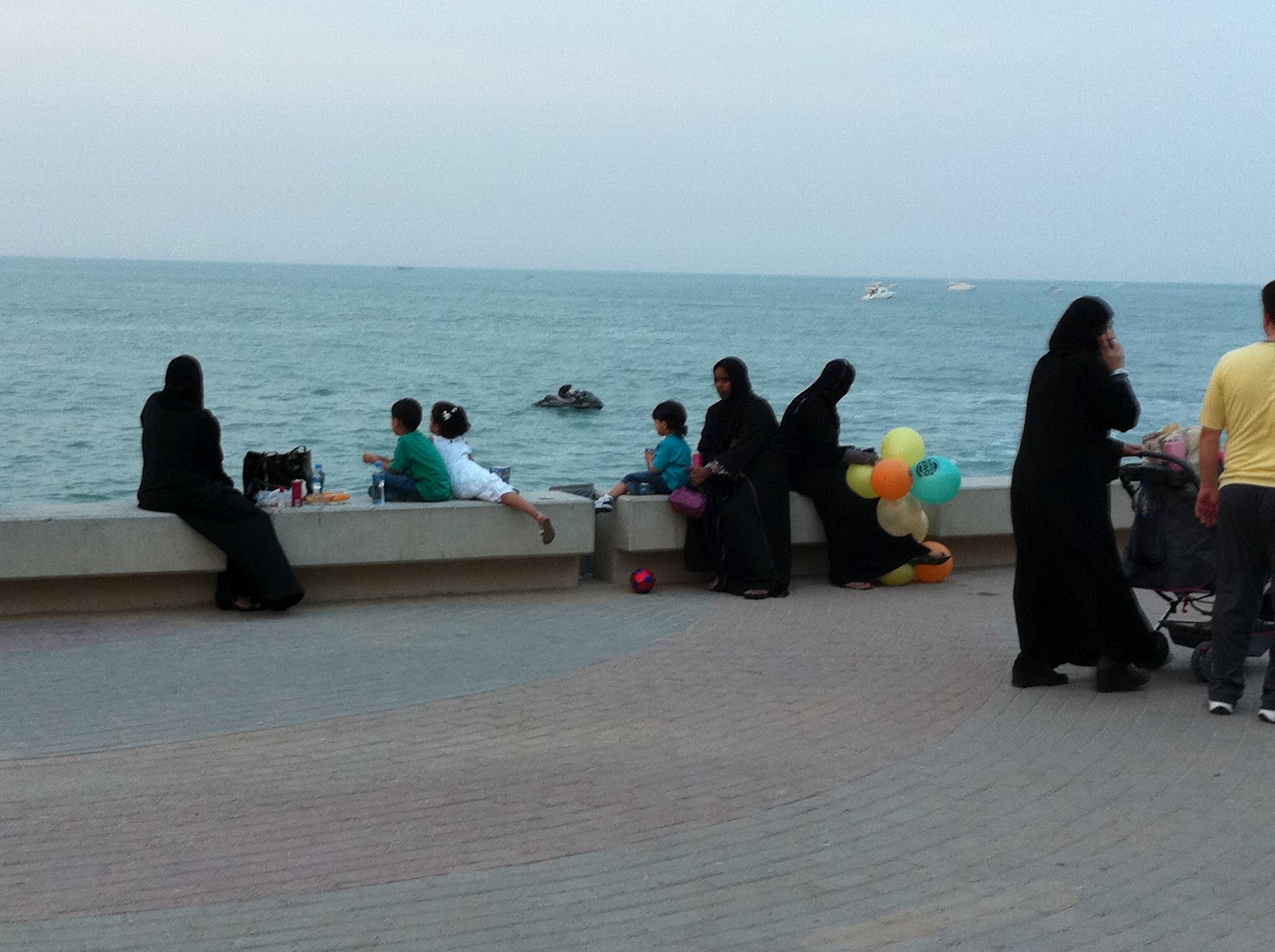
When we arrived in Kuwait, the Bambina had already been around nominally Muslim families in Madagascar, but none of them practised their faith in a visible way. So Kuwait was the first place my kids saw men in dishdashas and women in abayas and headscarves. 


Some women even had their faces and hands covered, something neither of our children had ever seen a lot of in Madagascar, Italy, or France. In France, it is against the law for any person to go with her or his face covered in public. And in public schools in France, teachers and students are prohibited from wearing any "ostentatious" religious signs. 

Our new cultural and religious environment came as a shock to our kids. I can remember the Bambino - age two - seeing for the first time in his life a woman fully decked from head to toe in a black abaya that also covered her face. We were in the restaurant of the Marina Hotel in Kuwait, serving ourselves at the buffet. The Bambino looked up at this woman with a black sheet over her head, pointed his little index finger at her and said "Fantôme!" (Fantôme is the French word for "ghost"). We were ready to burst out laughing because, yes, she did look like a ghost. A black ghost.


If I had to put a label on the Frenchman and me, I would say that we were secular humanists.  We want our children to question all beliefs - their origin, their rationale, and the historical accuracy of any "sacred" book that expounds a belief. When our children are confronted with a rule or moral code, whether found in a religious book or elsewhere, we want them to ask themselves whether that rule or moral code seems fair - whether it makes ethical senseWe want our kids to be skeptics. We want them to be as skeptical about the veracity of any major religion as they would be about the existence of, say, Zeus or Odin, until someone can show them evidence that requires a different conclusion.

On the other hand, we also want our kids to be open-minded to new points of view. And we want them to respect and love people for who they are, not for their beliefs.  We want them to be good to people of all beliefs, persuasions, and backgrounds, for the sake of being good.

So how do we do this? First, I try to expose my kids to all kinds of myths, from Greek, Norse, and Egyptian myths, to the stories in the Bible, to the myth of Santa Claus. And I ask them what they think of these stories.  Does the story make sense? Do they think the story is true? Do we have any evidence that it's true? When the Bambina asked how the earth and people came to be, I told her about how evolution works but I also told her that some people don't believe evolution is true, despite what scientific findings tell us. They believe that some kind of a god or gods created the world. In addition to finding some information for kids on the internet about evolution, I read to her the Genesis creation myth as well as the creation story in our Greek mythology book.  

Just as important as the preceding questions about what evidence we have to back up the story, I encourage them to think about the nature and character of the god in the story. When the Bambina saw a toy Noah's arc, I read the story of Noah's Arc to her ("God drowned everyone? Even the babies?"). During the annual Eid celebrations when the kids see sheep in the backs of trucks everywhere in Kuwait, waiting to be slaughtered, we talk about the story that the Eid celebration is based on - the story of how God asked Abraham to kill his son Isaac. The Bambina also learned very early on about the Christian Easter story - Jesus was killed on a cross as a human sacrifice for sins, and then rose from the dead. Conclusion: the god of the bible apparently thinks human sacrifice is a good thing?

Santa Claus has been of great assistance in creating young skeptical minds. When the Bambina was almost six years old, we had the following conversation: 
Bambina: "Mommy, is Santa real?" 
Me: "Well, what do you think? Have you ever seen reindeer fly?" 
Bambina: "No. And how does he deliver all the presents around the world in one night?" 
Me: "That's a good question. Do you think it would be possible for someone to deliver presents to all the children in the world in one night?" 

She didn't have an answer for that right away but the longer she thought about it the more skeptical she became. She was already a non-believer in Santa well before the following Christmas. I recently asked the Bambina if she was sorry not to have been able to believe in Santa for at least one or two years more. "No," she said. "I'm glad. I like knowing the truth."

Secondly, I try to encourage our kids be open to listening to new ideas and world views. I'm comfortable doing this because I'm also raising them to be skeptical. I've told the Bambina that she is welcome to explore religious beliefs if she wants. I've offered to take her to a church, a mosque, or any other religious place. So far, she's not interested. One of the Bambina's best friends at school is a member of the Church of Latter Day Saints. I've asked the Bambina if she would like to attend there one Friday (with me accompanying her). She said flat out no - she's not interested in three hours of church on her weekend!

Not all people agree with this approach. My good friend F, who is Muslim, thinks that our children will grow up with no moral compass or any notion of good or evil. She thinks that our children need something or someone to believe in in order to know right from wrong. To me, it is very obvious that our children know the difference between right and wrong. Whether we have a religious rule book or not, we know when our acts can hurt other people. And it doesn't take much reasoning to figure out that we don't want to be hurt, so we shouldn't hurt others, either.

My Christian friends think that our kids will still know what is right from wrong (they believe that god did give them a conscience, after all) but that our kids will lack larger meaning in their lives. I think my kids will define their own meaning. 

I love how living in Kuwait exposes our children daily to another major world religion.  There is a mosque right next door and we hear the call to prayer (very loudly!) five times a day (yep, at 4:15 AM, too). Most of our children's friends at school come from Muslim families. In the Bambino's Montessori school last year, during the Eid celebrations, the children learned all about the Hajj (the pilgrimage to Mecca that all Muslims are obligated to do at least once in their life). The teachers put a big black cube in the yard. The children pretended it was the Kabah and learned about the ritual of circling it seven times during Hajj. They also learned to roll and unroll the prayer mats and to recite the Arabic prayer. (We were okay with the Bambino learning the words to the prayer but told the teachers that we were not okay with the Bambino engaging in the actual prayer ritual of bowing prostrate on the prayer mats and praying). 

The Bambino (age 3) came out of his class one day that week and said to me "Mommy, I want to go to Macca and see the Kabah." 

I smiled. "Sure! If you want to do that one day when you're grown up, you can!." I didn't tell him that he would have to convert to Islam first. He'll learn about that later, if he wants. 

"But why do you want to go to Mecca to see the Kabah?" I prodded further.

"Because then we get to sleep in a tent!", he said.

"We're camping in the desert next week. You'll get to sleep in a tent then."

"Yay! I want to sleep in a tent!"

Phew. There's one request put to rest. Now if I could just getting him to stop calling mosques "castles". 


Thursday, 31 March 2011

Travel with Toddlers, AKA When Will This Hell End?


Traveling to and from Paris this past week with just the Bambino (now 23 months) reminded me how difficult travel with toddlers can be.

The flight back was eleven hours.  He slept for two of those hours.

He's too little to be interested in movies or even the short cartoons that the flight entertainment programme has to offer kids (who ARE these under-twos who will watch TV for longer than three minutes at a time?  It's not that I'm against TV for kids that age.  Mine would just never watch that long!).

His picture books are too short to last more than a few minutes each.

His toys were nothing new.

And after his two-hour nap, he wasn't tired in the least.  In fact, he was fuuuuull of energy.

What kept him busy in the end?  Some French maman had the ingenious idea of bringing a bag of toy cars for her three-year old son.  The Bambino was thrilled to play cars with this older boy.  Phew.
In between running up and down the aisles, pulling peoples eye-blinders down, covering people's TV screens and generally being a complete nuisance, that is.

In the end, I played the completely laissez-faire, slacker mom and let him run around while I remained seated in my chair, enjoying games of Solitaire and Air France's version of Trivial Pursuit.

Until he ran into the Business Class cabin and started trying to wake people up in there.  The flight attendant didn't like that too much and "suggested" that I not let the Bambino run around by himself.  Fortunately, meal time was just ending at that point, so I looked at her innocently, pointed to the meal tray in front of me that had not yet been cleared away, shrugged my shoulders and said, "What can I do?  I'm trapped." ;-)

Friday, 18 March 2011

Imperative for parenting in some parts of the world - a driver's licence


After years of living single in New York, London, and Paris, and then years with children in Paris, Rome and now Antananarivo, Madagascar, this Globetrotter Paris is - finally - going to get a real driver's licence.

You're probably wondering how it is possible that I don't have one.  Well, basically, I never got one in high school or university and then I was always limited for time as a full time lawyer and even more limited for time as a lawyer and mom.  And when I finally stopped working as a lawyer, when we moved to Rome, well, I was NOT going to try to learn to drive in Italy.  No way.

So now I am getting a driver's licence in Madagascar,

where there are no traffic lights,
where there are no stop signs,
where there are no signs for anything, really
where even the marking on the pavement is so faint that you can't see it
and where traffic jams and air pollution abound.

It's imperative.  We have a driver here but our next city will probably be a place where getting a full-time driver is not so normal, practical or cheap so, well, I may have to actually, er, drive.  Sigh.

Thursday, 20 January 2011

More Ramblings on Chinese Mothering

Since my last post on Why Chinese Mothers are Superior, the debate has been raging in the United States on Amy Chua's new book.  One blogger at Seattle Pi speaks positively about how western parents could learn from Chua's approach:

I'm not advocating cutting out all play dates and forcing your kids to play piano and violin in lieu of sports, but I do believe that there is a large core of truth in her approach. Assuming greatness in your child and teaching them to reach for the stars, rather than being praised for the barest of efforts makes sense.
This is similar to how I see it.  Can't we draw the good from this style of parenting rather than jumping on the judgment bandwagon?  Take the best and leave the rest, as they say?

Others have come out negatively.  Dr. AnnMaria de Mars, who posted last week on Why American Mothers are Superior, quipped:
Dr. Chua is raising her children to fit into the Ivy League mold.
Me, I’m raising my children to be themselves and to mold the world to fit them.
Dr. Chua insists that parents have misunderstood her point, and explains herself more fully this week in a Wall Street Journal blog:
Jokes about A+s and gold medals aside (much of my book is tongue-in-cheek, making fun of myself), I don’t believe that grades or achievement is ultimately what Chinese parenting (at least as I practice it) is really about. I think it’s about helping your children be the best they can be—which is usually better than they think! It’s about believing in your child more than anyone else—even more than they believe in themselves
It's the last part that's hard.  How do you get your child to understand that she can do something when she is convinced that she can't or that, if she can, it's not worth the effort.  I would love to teach the Bambina, age 6, to tie her shoelaces.  That's going to be a hard task here in Madagascar because she doesn't even where shoes with laces most of the time - just sandals or even flip-flops.  Getting her to care enough about learning to tie shoelaces by herself is going to be difficult.  Yet I think she is capable of it and I know that if she did learn, she would be proud of her achievement.

David Brooks of the New York Times raises another important point that I haven't seen articulated as well in any other critique of Dr. Chua's parenting approach.  In an Op-Ed, he accuses Dr. Chua of being "a wimp" because she refused to let her daughters navigate the complicated terrain of girls' sleepovers:
Practicing a piece of music for four hours requires focused attention, but it is nowhere near as cognitively demanding as a sleepover with 14-year-old girls. Managing status rivalries, negotiating group dynamics, understanding social norms, navigating the distinction between self and group — these and other social tests impose cognitive demands that blow away any intense tutoring session or a class at Yale.
Brooks goes on to write:

Participating in a well-functioning group is really hard. It requires the ability to trust people outside your kinship circle, read intonations and moods, understand how the psychological pieces each person brings to the room can and cannot fit together.
This skill set is not taught formally, but it is imparted through arduous experiences. These are exactly the kinds of difficult experiences Chua shelters her children from by making them rush home to hit the homework table.
I agree with this, which is why even though I draw a lot from what I have read about Dr. Chua's way of parenting, I can't see myself limiting my kids exposure to the social scene as much as Chua did.  

That being said, I don't think that sleepovers are the be-all-and-and-all of the pubescent social experience.  And sometimes, the sleepover scene can also be damaging to a girl's self esteem - if she is made to do things that she normally wouldn't do, made fun of, or just left out.   

At the end of the day, there probably isn't one way just like there isn't one child.  I like the idea of parenting a child to be a free spirit, western style.  I also like the idea of setting high standards for my child letting my child know that yes, she can do it.   Both western and Eastern approaches can make a contribution to a good parenting style.


Wednesday, 12 January 2011

Why Chinese Mothers are Superior

I just caught this article by Amy Chua in the Wall Street Journal.  The article is actually an excerpt from Amy Chua's new book, Battle Hymn of the Tiger Mother.

Here are some things that the writer says her children were not allowed to do:

  • have a playdate
  • be in a school play
  • complain about not being in a school play
  • not be the #1 student in every subject except gym and drama
  • play any instrument other than the piano or violin 
  • not play the piano or violin 
This list looks pretty different from standard western parenting practices.  Chua goes on to say:
"It's not that Chinese parents don't care about their children. Just the opposite. They would give up anything for their children. It's just an entirely different parenting model."
Ever since the Bambina started elementary school last September, I have pretty much let her take it at her own pace when it comes to learning to read.  She hasn't started getting written homework yet but she is supposed to do about 15 minutes of reading per evening.  Well, I've pretty much ignored this dictum, because I couldn't be bothered harassing her about it after school, because I've never been a big fan of homework anyway and because I wanted reading ultimately to be something the Bambina just feels like doing for leisure and not a chore.

But Chua's essay has had me in a frenzy.  Maybe I'm being too lax about her academic progress.  After all, my daughter already has a lazy disposition: she'll always do the least amount of work required to get away with something, meaning that even if she can do something, she'll never reach the goal because she won't be motivated enough, so she may never reach her full potential.

Another thing that hit me was Chua's assertion that western parents want their children to enjoy what they do but....from the Chinese point of view, a child is never going to really enjoy doing something until he or she gets good at it.  The Bambina's teacher at school has told me that the Bambina can read but that the Bambina has to want to read and so far, she is not so motivated to do it.  In the instances when I have watched the Bambina read, she does it syllable by syllable and it's a very slow process.  How will the Bambina ever enjoy reading a book for leisure if reading continues to be tedious and slow for her?

Inspired by the Chinese model, today I insisted that the Bambina do half an hour of reading with me.  I gave her the choice of reading in French or English - she chose French.  I insisted that she read three easy books with just one or two lines on each page and then three pages of a harder book with a paragraph on each page.

She ended up in tears twice - book too hard, she doesn't want to read with me around, and she kept insisting that she couldn't read and it wasn't worth insisting that she could read because it just wasn't true.  Yes, she could read individual words, but not books, she argued.  It's too difficult.

But we got through it and she was smiling in the end.  This morning in the car on the way to school she said to her friend, proudly, "you know, I can read now, I mean really read!"

This must be what Chua was talking about.  Sometimes, we really do know better than our kids and sometimes we have to insist that they can do it even if they insist that they can't.

I told the Bambina that she and I are going to be doing reading after school every day from now on.

I may start drawing more inspiration from Chinese mothers.

Thursday, 15 April 2010

Adventures in Baby-Led Weaning

It's been five months since the Bambino has been eating solids regularly.  This time around, we didn't bother with preparing any purées or buying special baby food.  We didn't bother doing anything, really.  We just handed him the softest morsels of the food we were eating - pears, bananas, plums (when each of these has been in season here in Madagascar), potatoes, beans (I do smash the red kidney beans a bit with a fork because I don't want them to get stuck in his throat, chicken (cut into small pieces), red meat if I can get it tender enough, well-cooked broccoli, cauliflower and carrots.

The advantages of this method:

(1) Far less work in preparation  - in fact no extra preparation at all - baby just eats whatever you're eating.  We have been taking some small precautions in preparing our own meals - no salt added during meal preparation (we just add it at the table) and no egg white in the meals until now.

(2) No texture issues and no long-term addiction to purées.  The Bambino does not appear to have any of the texture issues that the Bambina had and still has - he will eat mashed potates and cut up whole potatoes.  He will eat food mixed together or separated.   And he loves anything with sauce on it.  Compare this with the Bambina, who has an aversion to any liquid food - so no sauce on pasta, no gravy on meat, vegetables cannot touch meat, rice must be plain.  Apparently, if you let them explore the food themselves from the beginning, kids are less likely to develop these kinds of food hang-ups.  I have friends whose three and even four year old won't eat solid food - only purées - because that's what the child was fed as an infant and he or she never got used to anything else.

(3) You are respecting your child as a separate human being who can feed him or herself at his or her own pace rather than treating your child as an oriface into which you shovel food.  A lot of children have food issues later precisely because they resent "being fed".

(4) Your child gets used to being an automous earlier on - with hands mind you, not utensils (at least not yet for the Bambino).

The disadvantages - it's extremely messy.  Lots of food ends up on the floor, especially in the beginning (age 6 months) when baby is really more interested in exploring than actually eating anything. 
And, contrary to what the Gill Rapley says in her book on Baby-Led Weaning, this method does not necessarily make for a less picky eater in terms of taste preferences.  The Bambino will not eat plain vegetables.  He doesn't have a texture issue with them - he won't touch them if they're puréed either!.  He just doesn't like the taste.  But then, neither do I.   If I am honest, most vegetables have to be sautéed in lots of butter (or olive oil) and garlic, salted, and / or covered in a lovely sauce and mixed with noodles or rice or potatoes for me to eat them.  The Bambino seems to take after his mom in this regard (but I do try to avoid putting salt in his food).

Here on Gill Rapley's Baby-Led Weaning guidelines if you're interested.

Tuesday, 16 March 2010

The BCG Vaccine - is it worth getting?

I found this box of unused vaccines against Tuburculosis (aka the BCG vaccine) sitting in our refrigerator yesterday.  In the days prior to leaving for Madagascar, the Frenchman, being French, was intent on getting the Bambino jabbed with the BCG vaccine.  I think that France is the only country that actually even recommends this vaccine anymore.  You certainly never hear about it in the UK, Canada, the States or Australia.  (Oh yeah, I think they maybe still recommend it in Romania.  And Mexico).

I managed to convince the Frenchman to give a pass on this vaccine for the Bambino, for a few reasons.  Yes, there is tuberculosis in Madagascar.  But the BCG vaccine is not known for being that effective in preventing transmission of tuberculosis. Clinical trials in the UK have shown an efficacy of about 60 to 80 percent (which is already not great for a vaccine).  The efficacy rate falls as you get closer to the equator, sometimes to zero percent effectiveness.  No one really knows why.  But according to the World Health Organization, the BCG vaccines currently in use are produced at several sites around the world and are not identical to one another.   And it is not known whether the vaccines produced at one site are more effective than the vaccines produced at other sites

Since 2007, a new and apparently improved BCG vaccine is being used.  I haven't seen any data to suggest that it is, indeed, any more effective than the old vaccine.  And lookie here, The World Health Organization questions the safety of the current BCG vaccine.  From the WHO site:

BCG is widely used and the safety of this vaccine has not been a serious issue until recently.  There is concern that the use of the vaccine in persons who are immune-compromised may result in an infection caused by the BCG itself.  Also, even among immune competent persons, local reactions, including ulceration at the site of vaccination may result in shedding of live organisms which could infect others who may be immune-compromised.
The other thing that bothers me about the BCG vaccine is it can result in false positives on future tubuculin skin tests - which means that if your child ever wants to, say, work in the health care industry one day, he will have to get an X-ray to prove that he or she does not have TB!  The skin test won't suffice.

And then there is the post-vaccine bump, puss and permanent scar left on your child's arm.

My cousin Wolfgang, who happens to be a microbiologist and a travel doctor in Berlin, doesn't have a problem with the BCG vaccine per se but he does recognize its lack of effectiveness.  When I talked to him about whether to have the Bambino vaccinated, he recommended testing the Bambino for TB once a year, instead, using the tuburculin skin test.  If the test result is negative, no TB.  If the test result is positive, the child then gets an x-ray to ensure that he has simply developed immunity to TB (this is what usually happens when you are exposed to TB) and does not actually have TB.  If the child has developed TB, then the TB gets treated.   Most of the American parents that I have met here have chosen this route for their children.

Since arriving in Madagascar last July, I have surveyed lots of families of a few different nationalities about the BCG vaccine.  So far, all of the French parents that I have met have had their children vaccinated with the BCG vaccine and all but one of the non-French families have refused the BCG vaccine for their children (the one non-French vaccinated child I know was born in Mexico, where they give the BCG vaccine routinely at birth) -yet more evidence that the way you parent really is a cultural thing, even when it comes to vaccines!

Wednesday, 10 March 2010

Circumcision and HIV/AIDS - Is the link really that relevant?

If I see one more article suggesting that all infant boys should be circumcised so as to reduce their chances of getting HIV/AIDS, I am going to scream.  Honestly, think about this one people.  Circumcision is an excruciatingly painful procedure for most babies who undergo it (no, the EMLA cream does not work and most parents don't bother asking for the penile block).  Moreover, the procedure removes a tissue containing something like ten thousand nerve endings, reducing sexual pleasure by thirty to fifty percent. 

As for those studies that conclude that it reduces transmission of STDs such as HIV, I urge you to read more about them.  Their conclusions are of questionable value, both in terms of the sample size of the men who did end up getting HIV and in terms of their applicability to North America and Europe.

But let's just say that circumcision really will reduce your boy's chances of getting HIV in the future.  Please ask yourself this before you have anyone mutilate his penis:

Would you have your baby girl circumcised for the same reason? 

Seriously, if it could be shown that circumcising your baby daughter would reduce of her chances of getting or transmitting HIV in the future, would you have her circumcised?  Because the pain is the same or worse for a boy and, as with female circumcision, removing your son's foreskin will deprive him of a great source of pleasure in the future.

Tuesday, 16 February 2010

Here's My Mommy Card. Give me a call!


My sister just sent me this article from The Globe & Mail (Canadian newspaper) about "mommy cards"  Here's an excerpt:

In the past few years, "mom cards" of all descriptions have been showing up at baby groups, soccer fields and playgrounds.  Some are printed with cutesy one-liners ("Get your mommy to call my mommy") while others are emblazoned with damask or leopard prints.  But the basic information is the same: the mother's name, phone number and a job title such as Rugrat Wrangler or Annabelle's Mom.

A second-wave feminist may bristle at the notion of a woman labelling herself solely as a caregiver. But the women who use them say the modern-day calling cards celebrate a new identity.
I have thought about getting a "mommy card". Part of me thinks it is definitely a useful tool. I show up at a playgroup, meet some other moms and rather than forcing another mother to pull out her mobile phone with one hand while she balances the baby in the other arm, I just hand her my "mom card".

The other part of me would feel like an idiot handing them out. "My name is Caroline and I'm a mom. That's what I do."

Hmmm. This would go down especially strange with the French mamans who I meet here all the time. They are expatriates who have come to Madagascar owing to their husband's work and, although (generally) they are not working at the moment, I think the idea of a mommy card would make them cringe. I understand their point of view. Being a mother is something that I AM, whether I am working in an office, teaching English, or with my kids. It is not something that I DO. It is not my profession, or my hobby, or my side job. I wouldn't give myself the professional title of "mom" anymore than I would call myself "wife to the Frenchman", "Canadian", "woman" or even "human being".

Which brings me to an interesting cultural difference in parenting and identity. If you ask a North American stay-at-home mom what she does for a living, her response may well be "I'm a mom". Anglo-saxons women don't seem to have a problem with having their maternal role usurping their entire identity, at least temporarily.

The French (and I might add, the Germans and the Italians) would find the response "I'm a mom" to the question of what they do bizzarre because, as I have already noted, you are a mother whether or not you decide to stay at home to look after your children. (How many working dads respond "I'm a dad" when asked what they "do"?). Also, in saying that you are "a mom" to the question of what you "do", you are necessarily describing yourself exclusively in relation to someone else - your children - as if your role in life depended on that. If I answered, "I'm the Frenchman's wife", to the same question, it would seem seem strange and even archaic. Should it not seem equally odd identifying what I do by my status as a mother?

If you ask a French stay-at-home mom (and there aren't that many of them) "what do you do?", she may answer "I have chosen to stay home and look after our children" or "I'm on parental leave" (they get up to three years of unpaid congé parental - not bad) - an accurate description of what she does with her day. But I have never heard the line "je suis mére" to the question of what a French mom does.

So I am ambivalent about getting a mommy card.  The concept goes against my feminist sensibilities but hey, their practicality may outweigh the philosophical considerations.

Sunday, 20 September 2009

Babygroup à la française

Let me just start by saying that until last week, I had always believed that the very idea of a babygroup was anathema to your average French maman. First, by the time your average mom is ready to attend a babygroup, maman is already getting ready to go back to work (and she's looking forward to it). There are very few French stay-at-home moms.

Secondly, I'm trying to remember the last time I heard French mothers talking to each other about their babies, starting solids, or teething. I can't.

I have heard French moms discuss Sleeping Through the Night. It's the first thing they mention when they see your baby: " Est-ce qu'il fait ses nuits?" they ask, their voices carrying undertones of quiet desperation, in case your six-week old is not yet sleeping 12-hours straight.

But apart from the question of Sleeping Through the Night, which is an obsession of all occidental mamas, I don't think that most French moms enjoy discussing babies the way we Anglo-Saxon moms do. They would rather focus on getting their bodies back into shape, getting their perineum ready for sex again (French social security actually pays for the six sessions of ré-éducation at the physiotherapist. Not bad, eh?), getting ready to return to work, etc. Sitting around with other moms to discuss breastfeeding obstacles or which infant formula one's baby is drinking? What's the point?

So imagine my grande surprise when I discovered that here in Tana, there is (gulp)a French babygroup. Actually, it's a playgroup of mixed ages, including babies. Having now attended the French Playgroup, I have taken it upon myself to write up the following list.

You know you are attending a babygroup à la française when:

1. Half the mothers, er, didn't bring their baby. They left the baby at home with the nanny. They just came for the company.

2. You're the only one breastfeeding. If there is by chance another mother who is still breastfeeding her 10-week old, she will probably get up to find a more private place to do so. Heaven forbid that anyone see her breast bared in a non-sexual context!

3. At least one mother is smoking (I am trying really hard to imagine the reaction of my Anglo-Saxon mommy friends to someone lighting up a cigarette at a playgroup but it's hard to imagine it without laughing).

4. The topics of conversation include anything but babies or children. The idea is to have some enlightened discussion about something (anything!) else, such as where you will be going on vacation, where you have been looking for work, the new house, politics. We Anglo-Saxons might be able to learn something from the French about conversations concerning things other than teething, solids and crawling.

5. Should you start to actually talk about the babies, the discussion will be about which infant formula to buy.

6. You show up in a T-shirt and sweats and find the other moms wearing pencil skirts, high heels and blouses.

7. All the mothers are thin and have perfect bodies, even the ones who have just recently given birth. Also, there is a bowl of cookies on the table but no one is eating them except you.

8. None of them have ever heard of, or care about, Dr. Sears, Dr. Brazelton, Dr. Weissbluth, Dr. Ferber, Dr. Grandsenne, Dr. Rufo or any other famous doctor, American, French or other, who has written some treatise on raising a baby. However, their own child's pediatrician is God.

All this to say that parenting is definitely cultural.