Tuesday, 22 October 2013

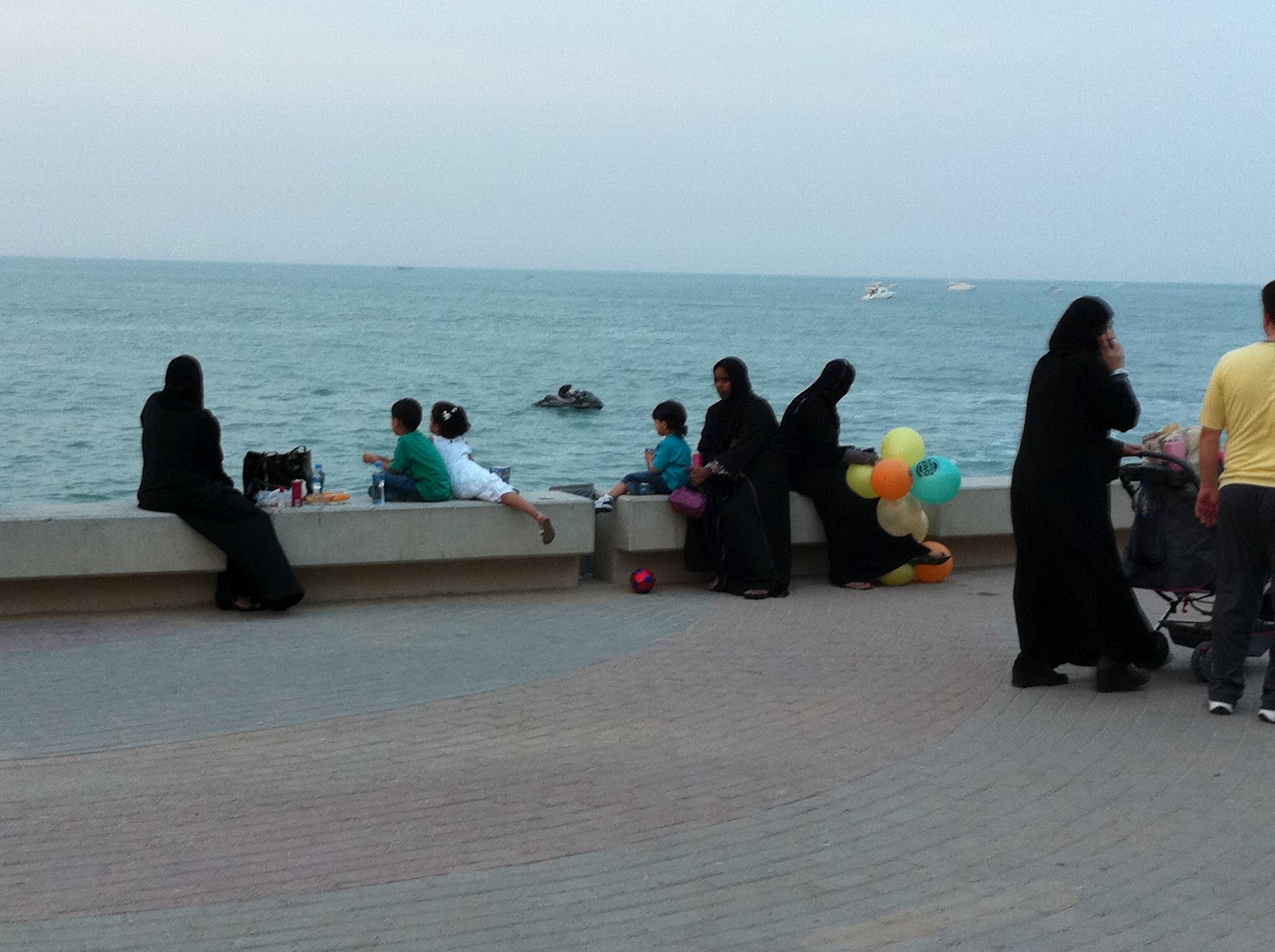
That moment when you realize that you really are in another part of the world...

Kuwait has so many street cats, maybe as many cats as people. Most of the cats you see hiding under parked cars or meowing from rooftops are feral and it's impossible to pet them, let alone pick them up. Even if you wanted to adopt one of these cats, you couldn't. They're not meant to be domesticated.

And then you happen upon some poor wretched cat that is not feral, just living in the street, very friendly and (dare I say) cuddly, begging you for some food. Here is a beautiful Persian cat that lives just outside our house. She's one of these cats.


Something happened to her tail. I don't want to know what it was. It's too painful to think about and I can't stand to look at it. It has puss coming out of it sometimes, and today I finally couldn't take it anymore and I took her to the vet to get her treated with antibiotics.

And here was my Kuwait moment - my moment when I thought to myself, "This part of the world really is very different from the place where I grew up". I arrived at the veterinary clinic, I took a number, I sat down with the cat in her cage (yes, I know, poor kitty) and here is what I saw:


Yes, that's a bunch of Arab men holding falcons. They traditionally use falcons for hunting, although I'm not sure that these men do. They might just keep a falcon as a pet. It was a bizarre scene - me with my stray cat and eight men that look like they're wearing pyjamas holding a falcon on their finger.

I think I'll send the photos to National Geographic.

Monday, 21 October 2013

Your kids' jeans made here in the third world


Workers at the factory.  They get paid about 40 dollars a month,
according to the head of the factory.  That's a low wage,
even by Malagasy standards.  Our nanny gets paid about 125
dollars per month.

A couple of years back when we were living in Antananarivo, Madagascar, I had the opportunity to visit a local factory where name brand children's jeans were manufactured for export to Europe.  

Let me just say that I have always been a big supporter of free trade and free movement of capital.  While some people might complain about the loss of manufacturing jobs in developed countries to China, India, Bangladesh, or Madagascar, my reply has always been, "More power to the Chinese, the Indians, the Bangladeshis, and the Malagasy!".  I'm happy for them to have jobs and opportunities.

It is therefore with a bit of sadness that I am revealing these photos.


Outside the factory, tons of eucalyptus wood cut from Madagascar forests
and burned to make hot water to wash and treat the jeans.
The factory head maintained that they contributed to tree replanting too.  I suppose there may be good arguments to use eucalyptus trees instead of say, gas, but I tend to think that the resulting carbon footprint must be huge.
Blue toxic waste is the byproduct of washing, bleaching,
dying and chemically treating the jeans to create the
"stone-washed" and "acid-washed" look (Note to self: don't buy these jeans).  The waste gets
dumped in uncontrolled landfills and leaches into rivers,
lakes, and the soil.
Children's jeans ready for export


As I toured the factory and saw the hundreds or workers labouring over fabrics and machines, I thought to myself, well, at least this factory gives them a job. Many people in Madagascar live in abject poverty and have no employment at all.

"And can I assume the employees get to make a living wage here, unlike so many in this country?" I said out loud to the factory manager showing me around.
"Mais NON ! They earn 80 US dollars a month."
80 US dollars a month would allow you to live in Tananarive, but not very well. You would definitely need other income earners in the family. 

So there you have it. The next time you buy jeans for your kids, let your mind travel to the factory where those jeans were made. I would never suggest boycotting jean purchases, but I definitely don't buy stone-wash or acid wash jeans now. 

Wednesday, 9 October 2013

Five Bad or Overrated Tips for Flying with Children

We've just booked our tickets back to France for Christmas (annual ski trip in the Alps!). Choosing the best times to take a plane with kids made me think of some "traveling with kids" tips that I have never followed, or stopped following very early on.

1) Bring snacks.

The issue with snacks is two-fold. First of all, the snack often doesn't get eaten. How could this be the case, you ask? Kids are hungry all the time, after all, especially when they're bored. The snacks you pack don't get eaten because you decided to stop at a coffee shop in the airport instead, or because it was an overnight flight and your kids slept, or because well, they didn't fancy the four-hour old peanut butter sandwich smushed at the bottom of your purse.

So the food ends up sitting in your purse or bag - dead additional useless weight that you have to carry. You discover it four days later while cleaning out your purse in your hotel room (so that's what that smell was!).

Secondly, there is the crumb, stickiness, and general mess factor. Chocolate is a huge no-no for this reason. Chocolate melts in hands at room temperature. Imagine what your 3-year old will look like after downing that Hershey's during the transatlantic flight. Yes, I know you brought baby wipes, but the baby wipes will only get his face and hands. Have you taken a look at his shirt? Do you really want to have to change his clothes for that?  Cookies and muffins create lots of crumbs everywhere, including on your seat, and you're stuck with those crumbs for the rest of the flight. No matter how much you try to dust off that seat, you'll still be left with half the snack under and around your three-year old's (and your) butt.

Fruit is often too sticky and does not satisfy appetite. In fact, it increases it. That apple you just ate is going to make your stomach growl for more food. Then there is the fact that if you're going to pack something healthy and not some pre-packaged industrial junk, you're going to have to bring it in a container - more things to carry - and you're stuck with a dirty container for the rest of the trip.

So, no, this globetrotter mom does not bring any snacks for long plane or train trips. No really, I bring no snacks for the kids. None.

And what if my kids get hungry in the airport? We stop at Starbucks (barely more acceptable than McDonalds. Just barely). They get a muffin, or maybe a short hot chocolate, and some water.  If we are truly fortunate, the Frenchman's frequent flyer card will get us into a lounge, and then the kids can have a proper meal. Otherwise, they eat at an airport take-out place and eat very little, if anything, on the plane. No containers or dirty bags to carry around, no mess in my purse. Crumbs, excess food, and spilt drinks land on the airport table and floor and are left there.

What about on the plane, I hear you asking? Well, here is one tip I do actually follow. I try to book overnight flights. Because on overnight flights, kids tend to sleep. Or if they don't, they can watch movies, or play on ipad or the Bambina might read a book. When we arrive at our destination, we have a proper breakfast or lunch somewhere, or if we arrive at nighttime, we just go to bed.

2. Order the kids' meal

The only thing more disgusting and unhealthy than airplane meals is the airplane meals for kids. It is also more likely to increase the crumb and mess factor, as it is more likely to contain things like cookies and chips. If your kids have to eat on the plane, just get them the regular meal. And once the flight attendant has served your meals, don't let her/him move on to the next row before you hand back every single item on the tray that you know your little one is not going to eat. You'll have much less clutter to deal with when the eating is over.

3. Bring toys

Why not bring toys? Kids need entertainment when they travel!
Kids need entertainment when they travel until about age of three, at which point they can watch the movies or sleep. And that two kilo / five pound bag of small toys you brought for your two-year old? He'll be done with it in about ten minutes or before you can say "Hey! Where're you going! You can't go in there, that's the business class cabin!"


One exception: if you can bring a few wax crayons and some paper or colouring books, this should hold your child's attention a little longer. Maybe even 20 minutes if you're very lucky. Don't hold your breath, though.

But even if the toys only occupy them for half an hour, it's something, right? But guess who will eventually have to carry them... You. Yes, I know, your toddler has a carry-on suitcase with wheels on it that she can pull with her. Do you think she'll be able to manage when you're on the escalator, when you're going through doors, or when your racing to the gate because they changed the gate number at the last minute and your gate is now at the other end of the airport? And once you've reached your destination, guess who will have to deal with the toys littering the hotel room floor... You. And guess who will be stuck looking for them when they are left at the airport or in the hotel room...Yes, you, while your little one is howling because they're lost.

But my kid will be bored if I don't bring toys, you say. Do you own an ipad? Does it have games on it? Does it have an app for painting or colouring? Trust me, those ipad apps are going to hold your kid's attention much longer (and be far more educational) than that new plastic truck you picked up at Boots drugstore yesterday. You can also bring one or two small books, preferably ones that your little one hasn't heard yet. No more - they can add a lot of weight to your bag.

4. Accept the airline's goodie bag for kids

Flight attendants typically provide little goodie bags for children on a long-haul flight. These bags often contain pencil crayons, a small colouring book or an activity book, sometimes a furry toy. The problem with them is that the activity book is rarely age appropriate - by the time your child is old enough to actually read the instructions and do the activities, he or she will not likely to be very interested in completing it. The pencil crayons draw so faintly that the wax crayons you brought will be more effective. The colouring book is usually very small. The toy is, well, junk. The Bambina - age 9 - now routinely refuses the goodie bag. If the Bambino is sleeping, I refuse it on his behalf. If he's awake and insists that he would like it, I make a point of leaving the contents behind when we get off the airplane. It's just more junk that I don't want to carry and that I don't want in my house.

5. Bring large suitcases with lots of clothes, even if you could manage with carry-on suitcases.

Most tips for travel with children encourage you to bring as much as possible. Better safe than sorry after all. Bring numerous changes of clothes, the bottle warmer, extra diapers, toys, books, changing pads.

My take: bring what you absolutely have to bring, but if at all possible, bring it in carry-on suitcases, and don't check in the stroller. Waiting for luggage is that last thing you want to do when you've arrived at your destination. Waiting and searching for the stroller that never showed up on the carrousel or in the "special luggage" pile is pure hell when you have small children who just want to leave the airport. Kids' clothing doesn't take up much space. I've packed a week's worth of clothing for a toddler in one carry-on suitcase. I buy diapers at the destination. The stroller is a bigger problem, as some airlines force you to check it in. There is also greater risk that the stroller will be lost or broken than there is with other luggage. Just remember, generally speaking, the less checked in baggage, the better.

Tuesday, 1 October 2013

Driving in Kuwait. Yikes!

Seen today, on the Fahaheel Highway of Death (otherwise known as highway 30) going from Salwa to Salmiya: a mother in the driver's seat, an empty carseat in the back, and her under-two year old child sitting next to the mother in the driver's seat.

Here are some other things we see all the time while driving in Kuwait:


People talking on their phone while driving


Small children not in a car seat and not wearing a seatbelt, often moving around inside the car, sometimes even standing up and sticking their heads and arms out the window or sunroof!

People texting while driving

Here are the kinds of accidents and car wrecks that we regularly see:


We are continually surprised by the driving culture in this country and by the number of horrific accidents that we see, so much so that the Frenchman and I have created a Facebook page called "Too Many Car Accidents in Kuwait." Look it up for yourself.

Thursday, 26 September 2013

The nanny culture in the Middle East

Here are photos of pick-up time at the Bambina's school:


Notice anything unusual? Do you see many parents? Or do you see, when you look closely, a lot of Filipina domestic helpers? In this part of the world, it is not uncommon for the nanny or housemaid to play the principal role in raising a child. Our own housekeeper told me that her first job in Kuwait was working as a nanny for a Kuwaiti couple. She began her employment when the wife was still pregnant with their first child. She told me in her broken Sri Lankan English, "I not understand, ma'am. Baby born. She give me baby. And then I mother. I sleep with baby, eat with baby, stay with baby all the time. She no want baby."

Thanks to Kuwaitiful for originally posting this video for everyone to see. The Saudi Human Rights Commission (now there's a paradox if there ever was one) has released this touching video showing a Saudi mother welcoming her children with open arms when they arrive home from school - only to see the children run into the arms of their nanny.


As expats, we've had the luxury of being able to hire a full time housekeeper in both Madagascar and in Kuwait. In Madagascar, we hired someone full time to work partly as a nanny and housekeeper; yet even then, I made sure that I was always the mother to my kids.  I spent time with my son while our nanny/housekeeper cleaned the house. I also breastfed the Bambino on demand and well into his toddler years, so we had a lot of bonding time together!

In Kuwait, I have always made a point of making sure that I pick up both kids from school. It's not about the transportation. We have a driver. It's about connection. They don't want to see the driver or a nanny or a housemaid. They want to see their mom, and at this stage in their lives, I wouldn't want it any other way.


Tuesday, 24 September 2013

Raising Freethinking Globetrotter Kids

When we arrived in Kuwait, the Bambina had already been around nominally Muslim families in Madagascar, but none of them practised their faith in a visible way. So Kuwait was the first place my kids saw men in dishdashas and women in abayas and headscarves. 


Some women even had their faces and hands covered, something neither of our children had ever seen a lot of in Madagascar, Italy, or France. In France, it is against the law for any person to go with her or his face covered in public. And in public schools in France, teachers and students are prohibited from wearing any "ostentatious" religious signs. 

Our new cultural and religious environment came as a shock to our kids. I can remember the Bambino - age two - seeing for the first time in his life a woman fully decked from head to toe in a black abaya that also covered her face. We were in the restaurant of the Marina Hotel in Kuwait, serving ourselves at the buffet. The Bambino looked up at this woman with a black sheet over her head, pointed his little index finger at her and said "Fantôme!" (Fantôme is the French word for "ghost"). We were ready to burst out laughing because, yes, she did look like a ghost. A black ghost.


If I had to put a label on the Frenchman and me, I would say that we were secular humanists.  We want our children to question all beliefs - their origin, their rationale, and the historical accuracy of any "sacred" book that expounds a belief. When our children are confronted with a rule or moral code, whether found in a religious book or elsewhere, we want them to ask themselves whether that rule or moral code seems fair - whether it makes ethical senseWe want our kids to be skeptics. We want them to be as skeptical about the veracity of any major religion as they would be about the existence of, say, Zeus or Odin, until someone can show them evidence that requires a different conclusion.

On the other hand, we also want our kids to be open-minded to new points of view. And we want them to respect and love people for who they are, not for their beliefs.  We want them to be good to people of all beliefs, persuasions, and backgrounds, for the sake of being good.

So how do we do this? First, I try to expose my kids to all kinds of myths, from Greek, Norse, and Egyptian myths, to the stories in the Bible, to the myth of Santa Claus. And I ask them what they think of these stories.  Does the story make sense? Do they think the story is true? Do we have any evidence that it's true? When the Bambina asked how the earth and people came to be, I told her about how evolution works but I also told her that some people don't believe evolution is true, despite what scientific findings tell us. They believe that some kind of a god or gods created the world. In addition to finding some information for kids on the internet about evolution, I read to her the Genesis creation myth as well as the creation story in our Greek mythology book.  

Just as important as the preceding questions about what evidence we have to back up the story, I encourage them to think about the nature and character of the god in the story. When the Bambina saw a toy Noah's arc, I read the story of Noah's Arc to her ("God drowned everyone? Even the babies?"). During the annual Eid celebrations when the kids see sheep in the backs of trucks everywhere in Kuwait, waiting to be slaughtered, we talk about the story that the Eid celebration is based on - the story of how God asked Abraham to kill his son Isaac. The Bambina also learned very early on about the Christian Easter story - Jesus was killed on a cross as a human sacrifice for sins, and then rose from the dead. Conclusion: the god of the bible apparently thinks human sacrifice is a good thing?

Santa Claus has been of great assistance in creating young skeptical minds. When the Bambina was almost six years old, we had the following conversation: 
Bambina: "Mommy, is Santa real?" 
Me: "Well, what do you think? Have you ever seen reindeer fly?" 
Bambina: "No. And how does he deliver all the presents around the world in one night?" 
Me: "That's a good question. Do you think it would be possible for someone to deliver presents to all the children in the world in one night?" 

She didn't have an answer for that right away but the longer she thought about it the more skeptical she became. She was already a non-believer in Santa well before the following Christmas. I recently asked the Bambina if she was sorry not to have been able to believe in Santa for at least one or two years more. "No," she said. "I'm glad. I like knowing the truth."

Secondly, I try to encourage our kids be open to listening to new ideas and world views. I'm comfortable doing this because I'm also raising them to be skeptical. I've told the Bambina that she is welcome to explore religious beliefs if she wants. I've offered to take her to a church, a mosque, or any other religious place. So far, she's not interested. One of the Bambina's best friends at school is a member of the Church of Latter Day Saints. I've asked the Bambina if she would like to attend there one Friday (with me accompanying her). She said flat out no - she's not interested in three hours of church on her weekend!

Not all people agree with this approach. My good friend F, who is Muslim, thinks that our children will grow up with no moral compass or any notion of good or evil. She thinks that our children need something or someone to believe in in order to know right from wrong. To me, it is very obvious that our children know the difference between right and wrong. Whether we have a religious rule book or not, we know when our acts can hurt other people. And it doesn't take much reasoning to figure out that we don't want to be hurt, so we shouldn't hurt others, either.

My Christian friends think that our kids will still know what is right from wrong (they believe that god did give them a conscience, after all) but that our kids will lack larger meaning in their lives. I think my kids will define their own meaning. 

I love how living in Kuwait exposes our children daily to another major world religion.  There is a mosque right next door and we hear the call to prayer (very loudly!) five times a day (yep, at 4:15 AM, too). Most of our children's friends at school come from Muslim families. In the Bambino's Montessori school last year, during the Eid celebrations, the children learned all about the Hajj (the pilgrimage to Mecca that all Muslims are obligated to do at least once in their life). The teachers put a big black cube in the yard. The children pretended it was the Kabah and learned about the ritual of circling it seven times during Hajj. They also learned to roll and unroll the prayer mats and to recite the Arabic prayer. (We were okay with the Bambino learning the words to the prayer but told the teachers that we were not okay with the Bambino engaging in the actual prayer ritual of bowing prostrate on the prayer mats and praying). 

The Bambino (age 3) came out of his class one day that week and said to me "Mommy, I want to go to Macca and see the Kabah." 

I smiled. "Sure! If you want to do that one day when you're grown up, you can!." I didn't tell him that he would have to convert to Islam first. He'll learn about that later, if he wants. 

"But why do you want to go to Mecca to see the Kabah?" I prodded further.

"Because then we get to sleep in a tent!", he said.

"We're camping in the desert next week. You'll get to sleep in a tent then."

"Yay! I want to sleep in a tent!"

Phew. There's one request put to rest. Now if I could just getting him to stop calling mosques "castles". 


Thursday, 19 September 2013

Back to Life in Sunny Q8

Yes, I know, it's been a long time since I've updated this blog but I've made a resolution to keep it up. We've recently returned from a three-month vacation back "home" in France. I have to say, I never tire of Europe. Who could get tired of this?

 A vineyard behind our house

 The Château d'Amboise

 A scene from a bike trail in the Loire Valley

 Apples getting ripe, in the yard of friends who live in Ile de France (that's the region around Paris!)

The Bambino having fun in a tub of water in our lusciously green front yard on an August day.

Or what about about this?

A hilltop view from the village of Montflanquin the region of Lot-et-Garonne in Southwestern France.


And don't forget about this! We don't get this stuff in Kuwait! I think I averaged at least one glass of wine per day this summer. Maybe more. And dead pig. There was especially lots of wine, and dead pig in all its glorious forms - from saussison sec to shaved ham to barbeque pork sausage, at the village festivals that took place almost every weekend.


In Kuwait, there's no wine and there's no dead pig. At all. Not even in special stores for expats (Nope, this is not Dubai). There are no castles, no grassy hills, no apple orchards, no narrow cobblestone streets, and certainly no vineyards.

But there's the hot dry sun and the beach club.


There are the feral cats that visit our house and periodically produce a litter of kittens:


We pass by some incredible car wrecks that (sadly enough) provide entertainment for us (honestly, we can't even imagine how the car could have possibly ended up that way):


And there's the desert:


And best of all, the kids are back in school (yes)! 


And I have my computer again, so I'll be updating this blog more often.